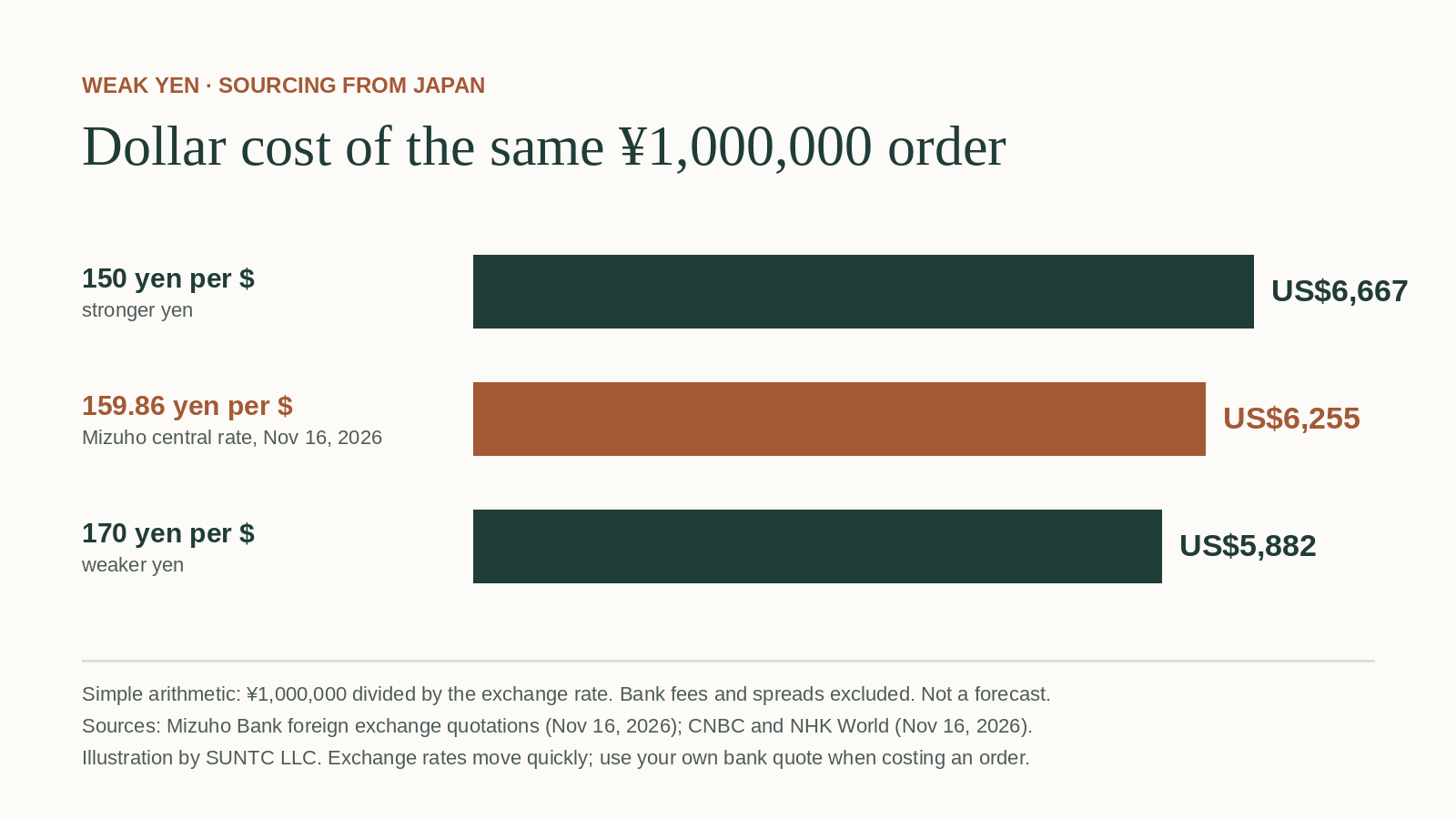
Quick answer: A weak yen makes sourcing from Japan cheaper in dollar and euro terms. On November 16, 2026, Mizuho Bank's reference rate was 159.86 yen per US dollar and 176.18 yen per euro, so a ¥1,000,000 order cost about US$6,255. The rate can move fast, though, and Japanese officials have warned against one-sided moves. Use the weak yen to test Japanese suppliers with a well-costed first order, not to place a currency bet.
What is happening with the yen right now?
The yen is close to the 160-per-dollar level, which markets watch closely. Here is what was reported in the last few days:
- Weak growth data. Japan's economy shrank by an annualized 0.1% in July–September, the first contraction in four quarters, according to NHK World (November 16, 2026). Private consumption fell 0.3%, and Cabinet Office officials said consumers are becoming more conscious of higher prices. Corporate investment rose 1.6%, driven by spending on semiconductor equipment and servers.
- The yen near two-month lows. CNBC reported on November 16 that the yen traded at about 159.69 per dollar and 176.04 per euro, "close to levels where US and Japanese authorities are believed to have intervened earlier this year."
- Official warnings. On November 13, Finance Minister Satsuki Katayama said she was observing one-sided and swift currency moves, as reported by FXStreet. That is a signal that Tokyo may act if the yen keeps falling.
- Central banks in December. The same CNBC report says futures markets price a high probability of a US Federal Reserve rate hike at the meeting ending December 9, while analysts are divided on whether the Bank of Japan will tighten in December. Either decision could move the yen.
Does a weak yen make sourcing from Japan cheaper?
Yes, if your supplier prices in yen and keeps its yen price. The table shows the same ¥1,000,000 order at three exchange rates. The middle row uses Mizuho Bank's published central rate for November 16, 2026. The other rows are examples for planning, not forecasts.
| Yen per US dollar | Approx. cost in US$ | Change vs. 159.86 |
|---|---|---|
| 150 (stronger yen) | $6,667 | About 6.6% more |
| 159.86 (Mizuho central rate, Nov 16, 2026) | $6,255 | Reference |
| 170 (weaker yen) | $5,882 | About 6% less |
For euro buyers, the same order was about €5,676 at Mizuho's euro central rate of 176.18 on the same day. Your bank's buying rate will be less favorable than the central rate, so use your own quote when you cost an order.
What does a weak yen not change?
- Supplier input costs. Many Japanese manufacturers buy energy and some raw materials in foreign currencies. A weak yen can raise their costs, and they may revise yen prices for later orders. Ask how long a quotation is valid.
- Import duties at home. The currency does not change your duty rate. For US imports, some categories from Japan face sector duties such as Section 232 on steel, aluminium, copper, auto parts and wood products; the commercial tracker border.bot lists these as of November 12, 2026. Confirm your classification and rate with a licensed customs broker.
- Lead times and MOQs. If many overseas buyers move at once, specialist suppliers may simply get busier. Price is only one part of a sourcing decision.
What does the weak yen mean for entering the Japan market?
If you sell into Japan, the picture is the reverse. A weak yen makes imported products more expensive in yen, while Japanese consumers are already price-conscious, according to the GDP report above. Before you set Japan prices, model your yen price points at more than one rate, decide who carries currency risk with your importer or distributor, and check whether your product is still competitive with local alternatives.
Also check product rules, not only prices. From November 22, 2026, Japan adds LC-PFCAs and related substances, chlorpyrifos and MCCPs to its list of Class I Specified Chemical Substances under the Chemical Substances Control Law. ChemRadar (October 10, 2026) reports that products using them, such as certain lubricants, coatings, water- and oil-repellent treated textiles and fire extinguishers, may no longer be imported from that date. If you sell treated textiles or coated products, ask your manufacturer for written confirmation of the chemistry.
How should you plan a Japan order while the yen is volatile?
Use this checklist before you confirm an order from a Japanese supplier:
- Agree the currency. Confirm whether the quotation is in yen, dollars or euros, and how long the price is valid.
- Cost at three rates. Calculate landed cost at today's bank rate and at a stronger and weaker yen, as in the table above. If the order only works at today's rate, it is a currency bet.
- Match payment dates to your FX plan. Know when deposits and balances are due. Ask your bank whether a forward contract makes sense for those dates.
- Check duties and compliance. Confirm the HS code, duty rate and any product rules in your market with a broker before you order.
- Start with a sample and a pilot order. Approve samples, packaging and labels first. Use the first order to learn real lead times and quality.
- Write down the specification. Japanese suppliers often work to precise specifications. Clear drawings, tolerances and inspection criteria help avoid misunderstandings.
SUNTC view: The weak yen is a good moment to open conversations with Japanese manufacturers you have been considering. Choose them for quality, reliability and fit, and treat the exchange rate as a bonus that may not last.
Frequently asked questions
Is the weak yen a good reason to start sourcing from Japan?
It can help, but it should not be the only reason. Japan suits buyers who need consistent quality, specialist products or reliable documentation. The currency can reverse quickly, so check that your business case still works at a stronger yen.
Should I pay Japanese suppliers in yen or dollars?
Many Japanese suppliers quote in yen. Paying in yen lets you benefit from the current rate but leaves you exposed until payment. Ask your bank about fixing the rate for a known payment date, and agree the invoicing currency before the order is confirmed.
Will the yen stay near 160 per dollar?
Nobody can promise that. Japan's finance minister warned on November 13, 2026 about one-sided moves, and markets are watching central bank decisions in December. Plan with a range of rates, not one forecast.
Does the weak yen help or hurt companies entering the Japan market?
It usually makes imported goods more expensive for Japanese buyers in yen terms, at a time when consumers are price-conscious. Exporters may need to review yen price points, margins and pricing terms with distributors.
Plan your Japan sourcing or market entry with SUNTC
SUNTC LLC helps international businesses with Japan and China sourcing, including supplier research, quotation comparison, and sample and order coordination. For companies entering Japan, we support market assessment, route-to-market planning and partner outreach. Send us your product, target quantity, destination and timing, and we can discuss a practical first step. We do not give currency, legal or customs-classification advice.
See our Japan sourcing services and our Japan market-entry support, or read how to validate a sales channel before entering Japan. Use the inquiry form below, email info@suntc.com or call +1 (737) 295-5815.