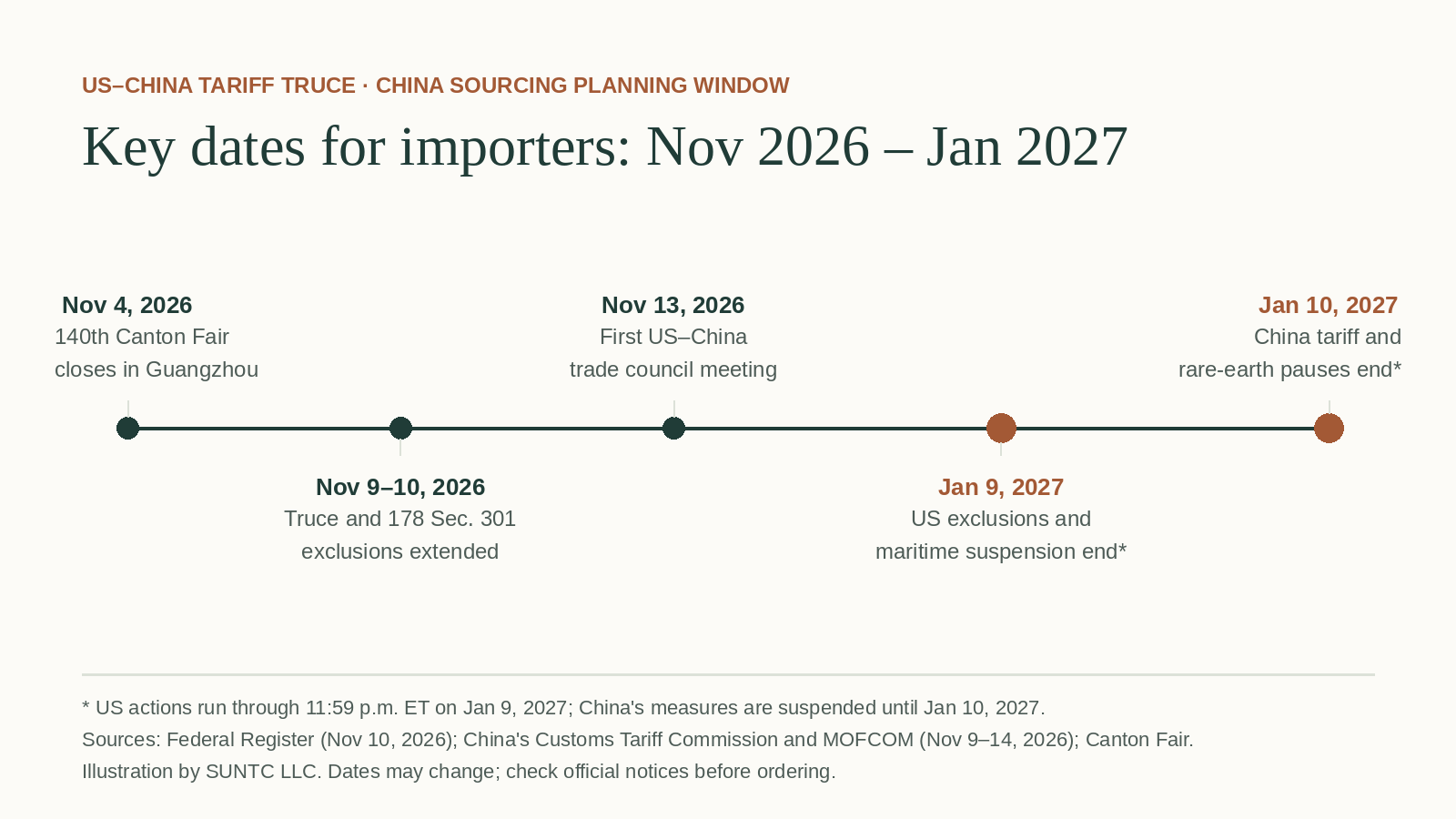
Quick answer: The US-China tariff truce now runs to January 10, 2027. On November 9–10, 2026, both governments extended their tariff pauses, and the US also extended 178 Section 301 product exclusions to the same window. If you are sourcing from China, use the next eight weeks to confirm classifications, cost each order with and without the current relief, and write tariff-change terms into purchase orders. Do not assume the deadline will move again.
What changed in the US-China tariff truce this month?
Here are the official changes, with dates. Each one has its own end date, so check them separately.
- US maritime measures are still paused. A USTR notice published November 10, 2026 keeps the Section 301 maritime, logistics and shipbuilding actions suspended through 11:59 p.m. ET on January 9, 2027. Those actions include fees on certain maritime transport services and duties on ship-to-shore cranes and other cargo handling equipment.
- 178 product exclusions remain. A second notice, also published November 10, extends all 178 current exclusions from the additional Section 301 duties under HTSUS headings 9903.88.69 and 9903.88.70. The extension also runs to January 9, 2027. USTR says it "may continue to consider further extensions" but has made no commitment.
- China's 24% countermeasure stays suspended. China's Customs Tariff Commission announced on November 9 that it will keep the 24% additional tariff on US-origin goods suspended for two more months. It will keep charging the 10% additional rate. This matters if you sell US products into China.
- Talks on a reciprocal tariff cut are ongoing. On November 13, the first US-China trade council meeting discussed an arrangement covering about US$30 billion of each side's goods, as reported by Xinhua via gov.cn on November 14. In September, the two sides agreed that tariffs on about 90% of the covered products would fall to most-favored-nation rates. No product list is cited here, so wait for the official notices before you assume your goods are included.
Interest in Chinese suppliers is still high. The organizer of the 140th Canton Fair, which closed on November 4, reported 352,000 overseas buyers. That included 38.2% more buyers from the EU and 22.2% more from the US than the previous session. Many companies are now turning fair contacts into first orders, and they will place those orders during this short tariff window.
Which China sourcing decisions depend on the January 2027 deadline?
For goods entering the US, the official notices tie the exclusions to goods "entered for consumption" in a set period. In practice, the date that matters is usually when the goods clear customs, not when you place the order or the goods ship. A container that leaves Shanghai in late December may not clear US customs until after January 9. Get your customs broker to confirm how this applies to your goods.
| Measure | Current status | Who should check it |
|---|---|---|
| 178 Section 301 product exclusions | Extended through Jan 9, 2027 (11:59 p.m. ET) | US importers whose 10-digit HTS code and product description match an exclusion |
| Section 301 maritime fees and crane duties | Suspended through Jan 9, 2027 | US importers, especially buyers of port and cargo-handling equipment, and freight planners |
| China's 24% additional tariff on US goods | Suspended until Jan 10, 2027; 10% still applies | US companies exporting to or entering the China market |
| China's expanded rare-earth export controls | Paused until Jan 10, 2027; earlier licensing still applies | EU and US manufacturers using magnets, motors or battery materials |
What should European companies watch?
EU buyers are outside the US-China deal, but some of its terms still reach them. According to Europe Mining News (November 12, 2026), China's Ministry of Commerce extended its pause on the expanded rare-earth export controls announced in October 2025 to January 10, 2027. Licensing for seven medium and heavy rare earths, in force since April 2025, is still active. Separately, Euronews reported on November 5 that the European Commission is preparing a new trade defence tool, which it expects to present by the end of the year. If you import from China into the EU, check for product-specific anti-dumping measures as well as these headlines.
How do you plan China orders during the tariff truce?
Use this checklist before you confirm any order that will arrive close to January 2027:
- Confirm the classification. Make sure your 10-digit HTS code (or EU CN code) matches the product as you will import it, and record why. An exclusion covers only products that match its exact description.
- Cost two scenarios. Work out the landed cost with the current relief and without it, so a tariff change does not take away your margin unexpectedly. Use official tariff schedules or your broker's figures, not estimates from a supplier.
- Plan backwards from customs entry. Allow time for production, inspection, booking, the sea voyage and customs clearance. Don't plan only to the ship date.
- Agree who pays duty. State the Incoterms rule clearly, and say who bears a duty increase that happens between the order and customs entry.
- Add a review clause. Agree to review price and delivery terms if the official tariff treatment changes before shipment. Get appropriate legal advice before you sign.
- Avoid large stockpiles. A rushed order that is too big creates storage, cash-flow and quality risks. You may do better by splitting shipments.
- Keep evidence. File invoices, packing lists and origin documents so that you can support your duty treatment if you are asked.
SUNTC view: This truce is a chance to reduce risk, not a reason to rush. Use it to make one well-documented first order, then grow based on what you learn about quality and lead times.
Frequently asked questions
When does the US-China tariff truce end?
The current US suspensions and the 178 exclusions run through 11:59 p.m. ET on January 9, 2027. China's suspensions run until January 10, 2027. Either side could extend or change them, so check the latest official notices.
Do the extended Section 301 exclusions cover my product?
Only if your product matches the exact 10-digit HTSUS number and description in the exclusion annexes. US Customs and Border Protection issues entry guidance. Ask a licensed customs broker to confirm your classification.
Should I bring forward orders from China before January?
Only if your numbers work under both cost scenarios. If the goods would arrive late or the order is mostly speculative, the extra stock may cost you more than the tariff relief saves.
Does the truce affect companies selling into China?
Yes. China keeps its 24% countermeasure suspended until January 10, 2027, but it still applies a 10% additional tariff to US-origin goods. Build both rates into your pricing for China market entry.
Turn the tariff window into a sourcing plan
SUNTC LLC helps international businesses with China and Japan sourcing. That includes supplier research, quotation comparison, and sample and order coordination, as well as market assessment for companies entering China. Send us your product, target quantity, delivery destination and timing. We can then discuss a practical first step. We do not give legal or customs-classification advice, and we do not promise any tariff outcome.
See our China sourcing services and our market-entry support, or read how to turn a Canton Fair sample into a reliable first order. Use the inquiry form below, email info@suntc.com or call +1 (737) 295-5815.