Quick answer: Chinese New Year 2027 sourcing needs to start now. China's official holiday runs from February 5 to 13, 2027, but many factories stop earlier: one logistics provider reports northern Chinese plants planning a January 25 to February 15 shutdown. If your goods take five weeks to make, most orders that must ship before the holiday should be confirmed by mid-December 2026, with ocean space booked at least four weeks before shipment.
When is Chinese New Year 2027, and how long do factories close?
The dates are now official. On November 5, 2026, China's State Council published the 2027 public holiday schedule (gov.cn, November 5, 2026):
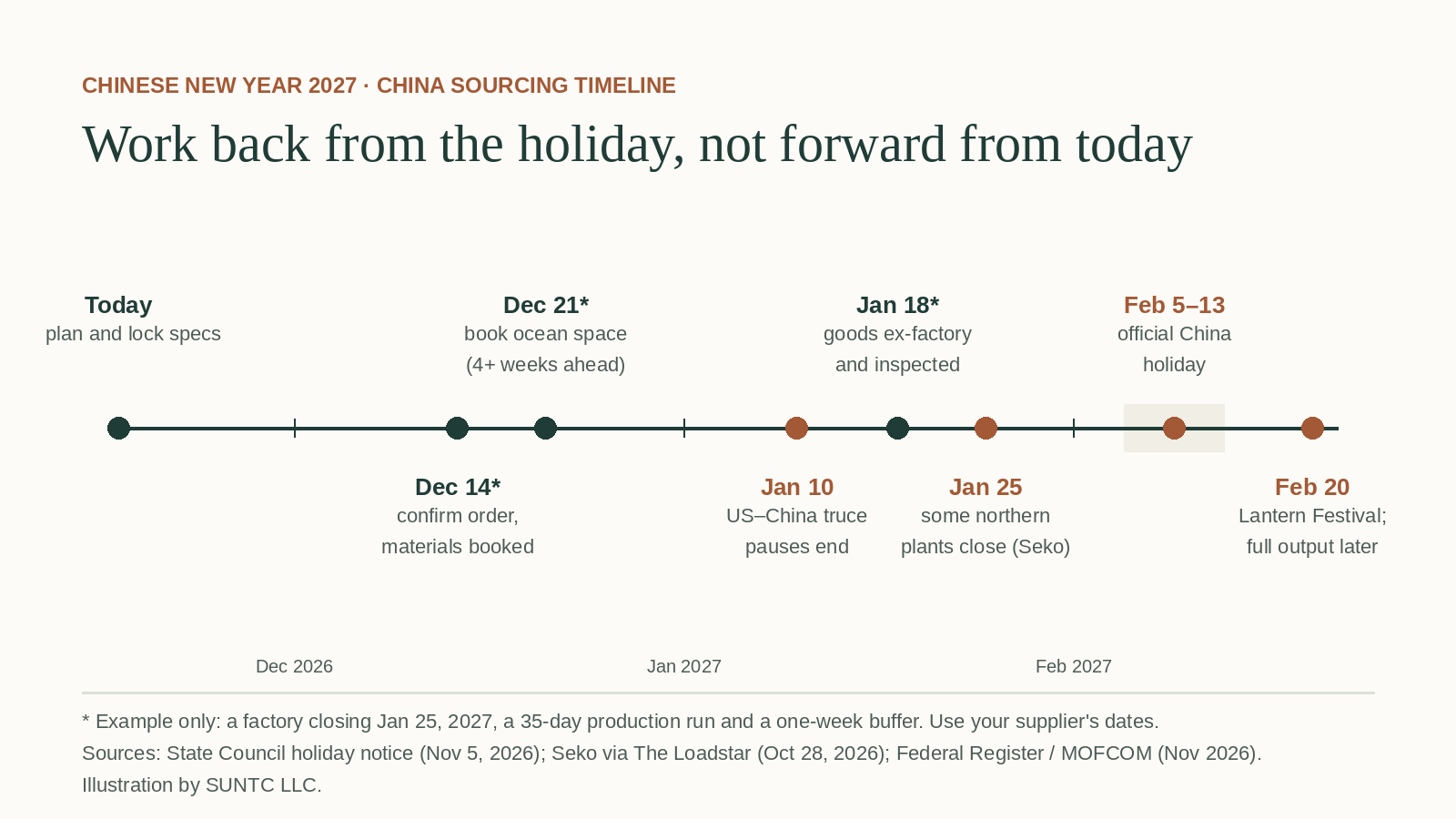
- Holiday: Friday, February 5 (New Year's Eve) to Saturday, February 13, 2027 – nine days.
- Make-up working days: Sunday, January 31 and Sunday, February 14.
- The festival itself falls on February 6, 2027, which is 11 days earlier than in 2026, as The Loadstar reported on October 28, 2026.
Factory closures are usually longer than the official holiday. In the same Loadstar report, Seko Logistics said few factories had formally announced their 2027 schedules, but plants it works with in northern China planned to close from January 25 to February 15. Some manufacturers stop up to a week before the festival and only return to full output after the Lantern Festival on February 20. In southern China, some operators may close three weeks before the holiday and need about two weeks afterwards to reach full production.
What does the freight market look like before Chinese New Year 2027?
Right now, ocean rates from China are easing, but that can change as pre-holiday cargo builds up:
- Transpacific is softening. Drewry's World Container Index of November 12, 2026 put Shanghai–Los Angeles at $7,416 and Shanghai–New York at $9,020 per 40ft container, both down on the week. Carriers announced eight blank (cancelled) transpacific sailings for the following week, up from four.
- Asia–Europe is flatter. Drewry had Shanghai–Rotterdam at $3,504 and Shanghai–Genoa at $4,168, with higher surcharges announced for the second half of November.
- Different indices, same direction. Xeneta's update of November 13, 2026 showed market averages of $8,360 (Far East–US West Coast), $11,249 (US East Coast) and $3,588 (North Europe) per 40ft container.
- Risks remain. Drewry notes that pre-holiday shipments may temporarily support demand, and lists labour negotiations at Los Angeles and Long Beach and geopolitical uncertainty as risks.
For importers, this is a planning window: space is easier to find now than it is likely to be in January. Rates above are spot benchmarks; your own quote will depend on contract, port pair and service.
Which other dates fall in the same window?
US and Chinese tariff and export-control pauses currently run to January 9–10, 2027, right in the middle of the pre-holiday shipping rush. We covered what that means in our US-China tariff truce planning note. If your landed cost depends on those pauses, plan for both outcomes rather than rushing extra stock.
How do you plan your last order before Chinese New Year 2027?
Work backwards from the date you need goods on a ship. This example uses a factory closing on January 25, 2027, a 35-day production run and a one-week buffer. It is arithmetic, not a forecast; replace each line with your supplier's and forwarder's real dates.
| Milestone | Example date | How it is set |
|---|---|---|
| Factory stops production | January 25, 2027 | Ask your supplier in writing; Seko reported this date for some northern plants |
| Goods ex-factory, inspected and packed | January 18, 2027 | One-week buffer before closure for inspection, rework and collection |
| Ocean booking confirmed | December 21, 2026 | At least four weeks before shipment, as Seko recommends |
| Order and deposit confirmed, materials booked | December 14, 2026 | Ex-factory date minus 35 days of production |
| Samples, packaging and artwork approved | Early December 2026 | Before materials are ordered; late artwork changes are a common cause of delay |
Then use this checklist with each supplier:
- Get four dates in writing: last day to confirm an order, production finish date, last dispatch date and reopening date.
- Ask about workers returning. Some factories take weeks to reach full capacity after the holiday. Ask what output they expect in late February and March.
- Freeze the specification. Approve the golden sample, packaging and labels now, so materials can be ordered before suppliers' own suppliers close.
- Book inspection early. Inspection companies are busy in January. Reserve a pre-shipment inspection slot when you confirm the order.
- Add transit buffer. Seko suggests building one to two extra weeks into transit plans around the holiday.
- Decide your fallback. If a shipment misses the window, decide in advance whether you accept a March shipment, split the order or pay for air freight.
- Plan the first post-holiday order. Placing your next purchase order before the break can help you avoid the queue when factories reopen.
SUNTC view: The earlier holiday is manageable if you treat mid-December as your real deadline. Buyers who are still choosing a supplier should consider a smaller pilot order now and the main order after the holiday, rather than pushing a new factory to rush a large first order.
Frequently asked questions
When does Chinese New Year 2027 start?
The festival is on February 6, 2027. China's official public holiday runs from February 5 to 13, 2027, with make-up working days on January 31 and February 14. Many factories close earlier and reopen later than these dates.
When should I place my last order before Chinese New Year 2027?
It depends on your production time and your supplier's closing date. For a five-week production run at a factory closing in late January, the order generally needs to be confirmed by about mid-December 2026. Ask each supplier for its own deadline in writing.
Will freight rates from China rise before Chinese New Year?
Nobody can say for sure. In mid-November 2026, transpacific spot rates were falling and Asia–Europe rates were broadly flat, but pre-holiday shipments and carrier blank sailings can push rates and space availability around quickly. Book early and compare quotes.
Should I use the holiday as a reason to change suppliers?
Not on its own. Switching suppliers just before Chinese New Year adds risk. It is usually better to keep your current order on track and use the quieter months after the holiday to sample and test new suppliers.
Plan your Chinese New Year 2027 sourcing with SUNTC
SUNTC LLC supports companies in Europe and North America with China sourcing, including supplier research, quotation comparison, and sample and order coordination. If you have orders that need to ship before the holiday, or you want to line up a new supplier for after it, send us your product, quantities, destination and timing and we can discuss a practical plan. We do not give legal, customs or freight-rate advice.
See our China sourcing services or China market-entry support, and read how to move from samples to a first order after the Canton Fair. Use the inquiry form below, visit our contact page, email info@suntc.com or call +1 (737) 295-5815.